Key Takeaways
- 77% of companies lack the data talent and skill sets needed for mission-critical areas, and only 12% run targeted programs to attract and retain data talent, according to a McKinsey survey of 70 data leaders published in 2025.
- U.S. database architects, the closest federal proxy for senior data engineers, earned a median $139,500 in May 2025, with the top 10% above $204,000 (U.S. Bureau of Labor Statistics).
- Data scientist employment is projected to grow 35% from 2025 to 2035, against 3% for all occupations, and every one of those roles depends on pipelines someone has to build (U.S. Bureau of Labor Statistics).
- Poor data quality costs organizations at least $12.9 million a year on average, and 59% of organizations do not measure data quality at all, according to Gartner research from 2020.
- Costa Rica exported $2.388 billion in ICT services in 2024 and knowledge-intensive activities made up 58% of its services exports, according to PROCOMER.
Data modernization roadmaps are falling behind schedule. The likely cause is not the technology, it's the people. 77% of companies in a McKinsey survey of data leaders say they lack the data talent and skill sets their mission-critical work requires. Data engineers, data architects and data scientists are all in short supply, and every report, forecast and AI initiative on your roadmap waits on someone to move the data into a place where it can be trusted. The tech layoffs of the past few years have not closed that gap. The BLS projects data scientist roles to grow 35% over the next decade, and each of those hires adds demand for the data pipelines that feed them.
For most U.S. companies, the practical answer is nearshore. Data engineering is high-volume work that encodes business rules that are often not written down or outdated. And it's also the work that touches some of the most sensitive records a company holds. Engineers need English proficiency, a working grasp of your business logic and your ecosystem, and the ability to communicate in real time with you and the team. The nature of data engineering, especially in the AI era, requires real-time coordination and cultural alignment with teams, regardless of where they're located. A team in Costa Rica, 1 or 2 hours behind Eastern Time, has the time zone alignment to do that. What follows is a sourced look at the data talent market and a framework for deciding which data work you keep in-house and which you can trust the nearshore team to work with.
What nearshore data engineering is and what it is not
Nearshore data engineering means hiring engineers in a nearby country, working your hours, to build and run the data management systems that move data from where it is created to where it is used. For a U.S. company, that usually means engineers in Latin America on a North American schedule. They should be working inside your own code repositories and cloud accounts, so the work and the data stay in systems you own.
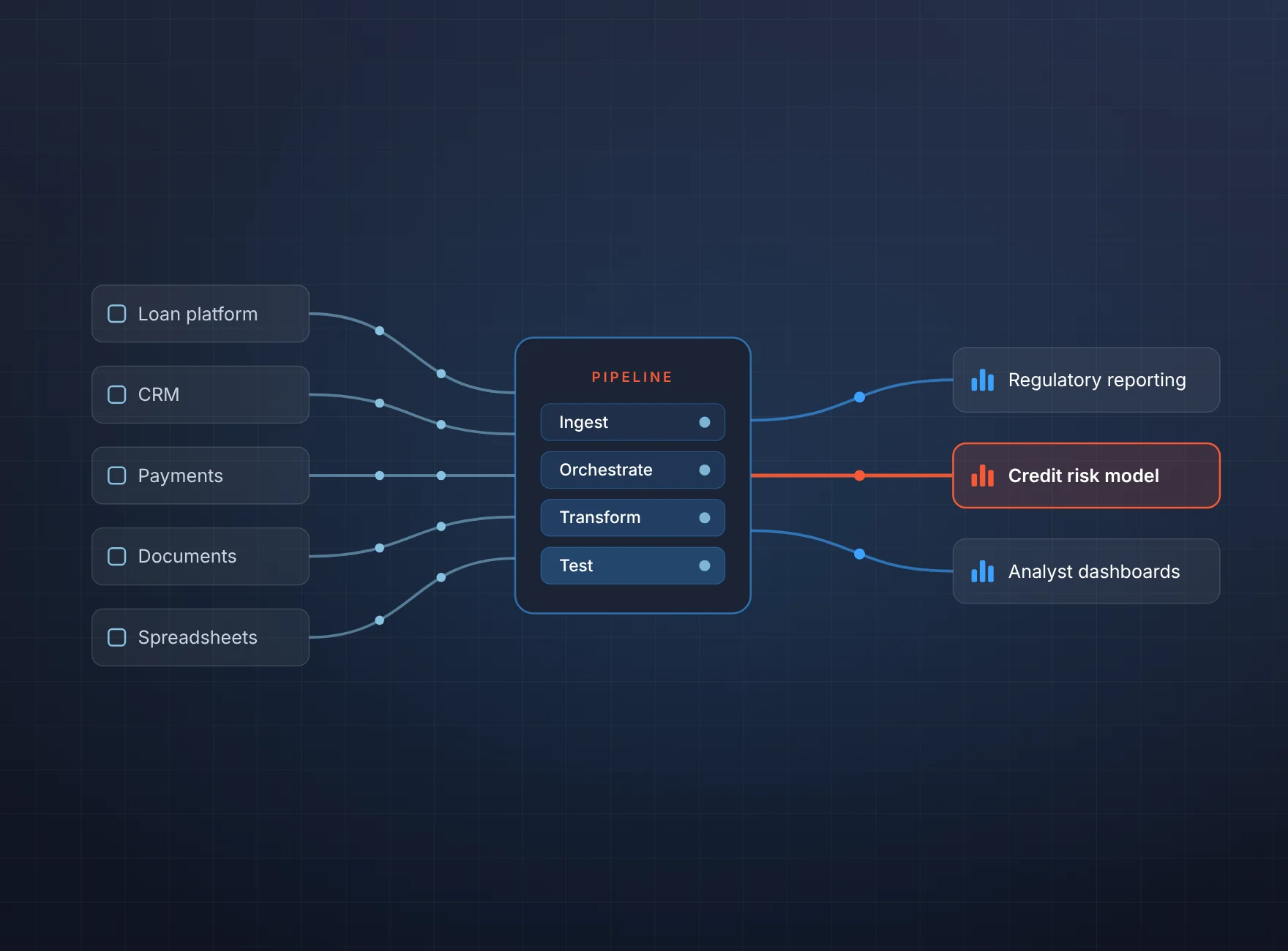
Consider a mid-sized U.S. lender with a dozen source systems: a loan origination platform, a CRM, a payments processor, a document store and a handful of spreadsheets that finance refuses to give up. Its analysts want one view of a borrower for regulatory reporting. Its data science team wants clean inputs for predictive analytics, starting with a credit risk model. A nearshore data engineer on that account spends the week writing the data integration code that pulls data from each system. They schedule those jobs in an orchestrator such as Airflow. They build the ETL processes that turn raw records into tables the analysts can trust. And they fix the job that broke when the CRM vendor renamed a field. That engineer joins the morning standup with the in-house platform lead and ships code the internal team reviews.
It is not buying a data analytics report, or handing a vendor a CSV export and waiting for a dashboard. It’s not offshore outsourcing of batch processing, where a vendor runs scripts overnight and sends files back in the morning. A data engineer is a software engineer whose product is reliable data, and the work draws on software engineering skills that take years to build.
The first skill is data modeling: deciding how a borrower, a loan and a payment relate to one another, how much detail each table holds, and how history is kept when a record changes. A modeling mistake gets inherited by every report built on top of it. The second is production code, mostly SQL and Python, plus big data technologies such as the Spark distributed processing framework once volumes outgrow a single machine. The third is cloud platform fluency. This includes cloud data warehouses, data lakes and lakehouses such as Amazon Redshift, Snowflake and Databricks. It extends to transformation tools such as dbt, and streaming pipelines built on systems such as Kafka for data that is needed in real-time. The fourth is operating discipline, which starts with data quality management. The engineer writes tests that catch a missing day of payments or a batch of duplicated loan records before an executive sees the number. The same engineer controls who can see sensitive fields such as Social Security numbers, and keeps the cloud warehouse bill from climbing because one query scans every table it touches.
Time zones matter more in data work than in almost any other kind of software work. Every pipeline encodes business rules: what counts as an active customer, when revenue is recognized, which records are duplicates. Those rules live in people’s heads before they live in code, and the engineer writing them needs answers the same day. A team one or two hours behind Eastern Time gets them. A team twelve hours away waits a day for each one.
Why nearshore data engineering is a talent decision before it is a cost decision
The common assumption is that companies look nearshore for data engineers to save money. The real driver is that they cannot find enough skilled talent at any price.
McKinsey's 2025 analysis of data talent puts numbers on the gap. In a survey of 70 data leaders at its 2024 Data Summit, 77% said their companies lack the data talent and skill sets needed for mission-critical areas, and only 12% said they have targeted programs to attract and retain that talent (McKinsey). The sample is small, so read it as a signal from practitioners rather than a market census. The direction is consistent with what hiring managers report: McKinsey describes talent pools for data engineers, architects and scientists as limited and hard to access, and notes that data talent churns faster than technology talent overall.
Open roles tell the same story. A search for data engineer jobs on Indeed returns 114,090 listings in the United States as of mid-October 2026. It’s true this includes reposts and duplicates, so the figure overstates the numbers somewhat, but its direction matches where employers say demand is heading. In the World Economic Forum’s Future of Jobs Report 2025, surveyed executives ranked big data specialists, fintech engineers, and AI and machine learning specialists as the three fastest-growing jobs in percentage terms through 2030. Every model those AI specialists build depends on AI-ready data infrastructure, and someone has to move and clean the data first.
Data engineers sit in an awkward spot in that market. McKinsey identifies them as the one role that overlaps both technology talent and data talent, which means they compete for candidates with software developers and analytics teams at once. A company that loses a data engineer loses the person who knows why the revenue table excludes test accounts, and the replacement starts by rediscovering that rule the hard way.
Demand is climbing on the consumption side too. The BLS projects data scientist employment to grow 35% from 2025 to 2035, against 3% for all occupations, and ties that growth to AI integration and rising data volume (BLS). Every data scientist hired adds demand for clean, reliable inputs to machine learning pipelines. The BLS makes the same point about database architects, attributing their projected growth to organizations' need for quality data infrastructure (BLS).
Cost still matters, but it is the second question. A team that lacks the engineering capacity to staff its pipelines pays for the gap in delayed projects and bad data, and the bill for bad data is larger than most salary lines. Gartner research from 2020 put the average annual cost of poor data quality at $12.9 million per organization, and found that 59% of organizations do not measure data quality at all (Gartner). A shortage of data engineers shows up first in that number, long before it shows up in a hiring report.
Data engineering salaries and market data for 2026
The BLS does not publish an occupation called data engineer. The two closest categories in its Occupational Outlook Handbook are database architects, who design the structures data lives in, and data scientists, who consume what data engineers produce. Senior data engineering compensation tracks closer to the architect figure, so we can use it as the anchor and treat the rest as context.
| Role (BLS category) | Median annual wage, May 2025 | U.S. jobs, 2025 | Projected growth, 2025 to 2035 |
|---|---|---|---|
| Database architects | $139,500 (bottom 10% below $86,240; top 10% above $204,000) | 69,500 | 9% |
| Data scientists | $120,230 | 275,600 | 35% |
| Database administrators | $104,620 | Not reported here | 0% |
| All occupations | Not applicable | Not applicable | 3% |
Sources: U.S. Bureau of Labor Statistics, Occupational Outlook Handbook: Database Administrators and Architects; U.S. Bureau of Labor Statistics, Occupational Outlook Handbook: Data Scientists. BLS has no data engineer occupation; these categories are proxies.
Two things in that table deserve attention. First, the spread for architects is wide, from under $86,240 at the bottom (a salary I have never seen for this role in 20+ years working with data architects) to above $204,000 at the top. Senior engineers who can handle warehouse and lakehouse design, reason about streaming semantics and own cost in a cloud warehouse sit in the upper half of that range. Second, the administrator line is flat at 0% growth while the architect line grows 9%. The market is paying for people who design and build data infrastructure, not people who only maintain it. The BLS also estimates about 24,800 openings a year for data scientists alone, each one a new consumer of pipelines.
Those figures are base wages. They exclude benefits, payroll taxes, recruiting fees, equipment and the months a seat sits empty while a search runs. A nearshore bill rate works the other way: it is fully loaded. First Factory's most recent rate data shows most staff augmentation placements in 2024 billed at $50 to $95 an hour, depending on skills and experience, with compensation, benefits, equipment, management oversight and replacement risk inside that number. The honest comparison is total cost per productive engineer, not hourly rate against salary.
Treat every published percentage of nearshore savings with suspicion. The pages that rank for this keyword quote savings of 40% to 65%, and none of them cites a primary source for the figure. No government or analyst dataset we could find reports a Latin American data engineering rate, so this post does not invent one.
The supply side in Costa Rica is documented by its trade agency. PROCOMER reports that the country exported $16.114 billion in services in 2024, equal to 17% of GDP, with average annual growth of 8%. ICT services accounted for $2.388 billion, knowledge-intensive activities made up 58% of services exports, and 420 services firms operate in its Free Trade Zones. PROCOMER names analytics among the services exported and, citing WIPO, ranks Costa Rica first in Latin America for ICT services exports (PROCOMER). Those are 2024 figures from the agency's own release, and they describe the services sector broadly rather than data engineering specifically.
How to decide which data engineering work to place nearshore
Not every part of a cloud data platform should move. The useful question is not whether to use a nearshore team but which work benefits from one. The answer depends on how much undocumented business context the work carries and how expensive a mistake would be.
| Work type | Nearshore fit | Why |
|---|---|---|
| Source ingestion and connectors | Strong | Well-specified inputs and outputs; testable at the source-system interface |
| Transformation and modeling (dbt, SQL, Spark) | Strong, with an internal reviewer | Business rules need sign-off, but the build, including ETL/ELT modernization, is repeatable work |
| Orchestration, monitoring and on-call for pipelines | Strong | Overlapping hours mean failures get fixed the same business day |
| Data quality tests and data observability tooling | Strong | High-value, often unstaffed in-house, easy to measure |
| Platform architecture and tool selection | Shared | Decisions need internal ownership; nearshore architects can lead the analysis |
| Data governance policy, access approvals and regulatory sign-off | Keep in-house | Accountability cannot be delegated, though implementation can |
Framework based on First Factory delivery practice; no external data source.
Criteria to apply before you place the work
- Confirm that the work can be described in a ticket with a definition of done, as Agile methodologies expect. Ingestion jobs and transformation models usually can, while a request to "fix our data" cannot, and the second kind of work needs an internal owner before it needs more engineers.
- Name the internal reviewer for every business rule. A nearshore engineer can write the logic that defines an active customer, but someone inside the company has to agree that the definition is right.
- Require the work to land in your repositories, your cloud accounts and your orchestrator. A pipeline that runs on a vendor's infrastructure is a pipeline you cannot take back.
- Check overlap hours against your load schedule. If your critical batch finishes at 6 a.m. Eastern, you want the people who own it awake when it fails, and a team one to two hours behind Eastern Time covers most U.S. business days.
- Ask how the partner handles data security in practice. Look for SOC 2 Type 2 certification, device management on every laptop, and least-privilege access to production data, and ask to see the controls rather than the logo.
- Ask how long engineers stay on an account and as an employee with your software development partner. Pipeline knowledge is tribal until it is documented, and turnover deletes it.
What retention does to a data team
McKinsey warns that purely transactional external hiring tends to produce underqualified hires who do not stay. The remedy is not to avoid outside engineers but to choose a dedicated team model where the same engineers stay on the account long enough to learn it.
First Factory's own retention record is a standout point that carries weight here. Employee tenure is over 4.5 years with nearly 50% of our team with us more than 5 years. Average client tenure follows with nearly three and a half years, and more than 25% of clients have stayed five years or longer. For data work, tenure is the control that keeps business rules from walking out the door.
When nearshore data engineering is the wrong choice
Nearshore data engineering fails in predictable ways. Nearshore outsourcing is the wrong choice when nobody inside the company owns the data. If the business cannot say which system is the source of truth for a customer record, adding engineers only produces faster pipelines that encode the disagreement. Fix ownership first, and the engineering becomes simple to staff.
It is the wrong choice when the work is a one-time extract. A single cloud migration with a fixed scope and no ongoing operation does not need an embedded team. A milestone-based project, or an internal engineer with a few weeks of focus, is cheaper and simpler.
It is the wrong choice when regulation requires that specific data never leave a jurisdiction or never be accessed by non-employees. Some health, defense and financial datasets carry those rules. A nearshore team can still build the pipelines against masked or synthetic data, but if the job requires direct access to restricted records, the contract and the controls have to be settled before the first ticket.
And it is the wrong choice when the goal is only a lower hourly rate. A nearshore delivery partner selected on rate alone tends to staff the account with whoever is available, and the McKinsey warning about transactional hiring applies directly. If cost is the only criterion, the savings disappear the first time a pipeline breaks and nobody on the account knows why it was built that way.
FAQ
What does a nearshore data engineer do?
A nearshore data engineer builds and maintains the data pipelines that move data from source systems into a data warehouse or lakehouse, transforms it into tested models, and keeps the jobs running. The engineer works in overlapping hours with the client team, inside the client's repositories and cloud accounts. The role is the same as an in-house data engineer; only the employer and location differ.
How much does a nearshore data engineer cost?
Most First Factory staff augmentation placements in 2024 billed at $50 to $95 an hour, depending on skills and experience, and that rate is fully loaded. Compare it with the total cost of a domestic hire rather than base salary alone. The BLS reports a May 2025 median wage of $139,500 for U.S. database architects, the closest federal proxy for senior data engineers, before benefits, taxes and recruiting costs.
Is it safe to give a nearshore team access to production data?
It can be, if the controls are in place before access is granted. Look for SOC 2 Type 2 certification, managed devices with remote wipe, least-privilege access and audit logging on production systems. For regulated data, build and test against masked data and limit direct access to the few roles that need it.
Which data engineering tasks should stay in-house?
Keep your data governance frameworks, access approvals and regulatory sign-off inside the company, because accountability for them cannot be delegated. Platform architecture decisions should have an internal owner even when nearshore architects lead the analysis. Ingestion, transformation, orchestration and data quality testing are usually the strongest fit for a nearshore team.
Why choose Costa Rica for nearshore data engineering?
Costa Rica operates one to two hours behind Eastern Time and does not observe daylight saving time, so overlap with U.S. teams holds year round. PROCOMER reports $2.388 billion in ICT services exports in 2024 and names analytics among the services the country exports. Our post on why Costa Rica works for nearshore development covers the broader case.
How do I start a nearshore data engineering engagement?
Start by listing the pipeline development work that has a clear definition of done and naming the internal owner for each business rule it encodes. Then choose a delivery model: Staff Augmentation embeds engineers in your existing team, while Scrum Teams deliver a defined platform workstream in two-week sprints. Most teams begin with one or two engineers on ingestion and quality before expanding.
Talk to a nearshore data engineering team
First Factory has delivered nearshore software development for U.S. clients for more than 25 years from its center in Heredia, Costa Rica, is SOC 2 Type 2 certified, is a Select partner in Anthropic's Claude Partner Network for teams building AI on top of their data, and backs every resource with a 30-day satisfaction guarantee. Book a call with our team to map which parts of your data platform a nearshore team should own. If you are still comparing options, start with our overview of engagement models or read our SOC 2 Type 2 announcement.