


Key Takeaways
- Agile nearshore development pairs sprint-based delivery with senior engineers in your time zone.
- 84% of developers now use or plan to use AI tools in their workflow, up from 76% in 2024 (Stack Overflow Developer Survey 2025). Your nearshore partner’s AI fluency is the new screening criterion.
- 67% of organizations have moved to outcome-based outsourcing, up from 45% two years prior (Deloitte 2024 Global Outsourcing Survey). Fixed-price contracts are losing ground to sprint-priced scrum teams.
- Latin American developer rates fell 7.1% in 2025 (Accelerance 2026 Global Software Development Rates Guide), but the real ROI is keeping the same engineers on your account for three years — not the hourly rate.
Agile nearshore development pairs short sprint cycles with senior engineers close enough to overlap your full workday. With 84% of developers using AI tools daily (Stack Overflow Developer Survey 2025) and 67% of buyers moving to outcome-based contracts (Deloitte 2024 Global Outsourcing Survey), what "good" looks like in a nearshore partner has shifted. So has what you should demand before signing.
Your last offshore engagement looked great on the quote and slipped on sprint three. You are not alone.
Each hour of time-zone gap between you and your engineers cuts real-time communication by 11.0%, immediately (Chauvin, Choudhury & Fang, Organization Science 2024). That is the math behind a 10-hour offshore gap that crawls and a 1-hour nearshore overlap that ships.
If you run engineering at a 50 to 500 person company, the bind is familiar. The median U.S. software developer earns a base salary of $133,080 — exclusive of benefits and other employer costs (US BLS, May 2024) — and the hiring cycle runs three to six months. Offshore quotes look cheap until you count the rework. And most "agile nearshore teams" never show you what a sprint actually looks like, or how to choose between staff augmentation, a dedicated scrum team, and fixed-price.
This guide shows the work. A real two-week sprint with a CST-overlapping team. The three engagement models and when each one fits. Seven questions every CTO should ask a partner. And the contrarian frame that beats the cost-leader pitch. By the end, you will know whether agile nearshore fits your roadmap, and exactly what to demand if it does.
What “agile nearshore development” actually means (and what it isn’t)
Agile nearshore development is the pairing of sprint-based, iterative software delivery with senior engineering teams in countries that overlap your business hours. For US clients, that almost always means Latin America. The model has two ingredients: agile methodology (Scrum, Kanban, or Scrumban) and nearshore proximity, defined as at least four hours of overlapping work time with the client.
It is not offshore-with-better-English. It is not just “cheaper US developers.” Three things in particular disqualify a vendor from calling itself agile nearshore: contractor-only engagement, asynchronous-by-default communication, and fixed-scope-only contracts. If your prospective partner staffs your project with contractors who roll off after six months, no shared sprint will save the engagement. If their default response time is “we’ll get back to you tomorrow,” they are running an offshore playbook with a nearshore zip code. And if they only sell fixed-price work, they have not adopted agile — they have adopted a label.
The market has already moved past those models. Deloitte’s 2024 Global Outsourcing Survey found that 67% of organizations now use outcome-based outsourcing contracts, up from 45% just two years prior (Deloitte 2024). Outcome-based contracts are the natural fit for agile delivery: you pay for sprints that produce working software, not for hours that produce status reports.
There is one more thing worth saying here, because most competitor guides skip it. Agile nearshore is not primarily a cost play. It is a continuity play. The differentiating asset is senior engineers who stay on the same client account for years and compound product knowledge in a way that offshore body-shops cannot replicate. The cost story is real but small. The continuity story is the one that moves the needle.
Why agile and nearshore reinforce each other (vs offshore)
Agile depends on tight feedback loops, and tight feedback loops depend on overlapping working hours. The most rigorous research on this lives in Organization Science: in a 2024 study of 12,038 employees at a Fortune 100 multinational, Chauvin, Choudhury & Fang found that each additional hour of temporal distance between collaborators reduces synchronous communication by 11.0% (Chauvin, Choudhury & Fang 2024).
Run the math on that. A 10-hour offshore gap can wipe out more than half of real-time collaboration. A 1-hour nearshore overlap barely moves the number. Now think about what agile ceremonies actually require. Daily standups have to happen synchronously, or they are not standups. Sprint reviews need stakeholder feedback in real time, or the next sprint starts with stale data. Unblocking conversations have to happen within the workday they come up in, or velocity stalls.
That is where offshore agile breaks. A daily standup that happens via Slack thread is not a standup — it is an async status update. A sprint review that the client watches on Loom 12 hours after the demo is not a review — it is a recap. The agile machinery is still in place, but the loops have all been stretched. Velocity falls. Pivot costs rise. Trust erodes.
Nearshore agile keeps the loops intact. Same workday. Same rhythm. Questions answered in real time, not overnight. A pull request opened in the morning gets reviewed before lunch. A blocker raised at standup gets unblocked by 2pm. A stakeholder priority that lands at noon makes it into the next sprint’s planning by Friday. That is what a two-hour overlap window unlocks, and it is the reason nearshore agile compounds while offshore agile decays.
Three engagement models inside agile nearshore — and when to pick each
Inside agile nearshore there are three real engagement models. Most guides treat them as interchangeable. They are not. Picking the wrong one is the single most common reason nearshore engagements fail in their first 90 days.
Staff augmentation
Staff augmentation is the right model when you already have a strong product owner, a working backlog, and tech leadership on your side. Senior nearshore engineers join your existing sprints, attend your standups, pick up stories from your Jira board, and ship code into your repos. You own velocity. You own the roadmap. The nearshore partner handles recruiting, retention, benefits, and developer success. This is the dominant model in mature engineering organizations, and at First Factory it is both the most popular and the most profitable engagement type — because it is the one that produces multi-year client tenure.
Dedicated scrum teams
Dedicated scrum teams are the right model when you do not have a product owner, or when the work is meaningfully separable from your in-house team. The nearshore partner provides a self-organizing pod — engineers, a scrum master, a tech lead, and QA — that works from your priorities but runs its own cadence. You bring the requirements; the team brings the process. This is the right model for new product lines, modernization projects, and engagements where your in-house team is at capacity.
Fixed-price projects
Fixed-price projects are almost never the right choice for software. The reason is structural: agile and fixed-scope contracts pull in opposite directions. Agile assumes you will learn during the project and want to change priorities; fixed-price assumes scope is locked. The 67% of buyers who have moved to outcome-based contracts (Deloitte 2024) have already recognized this. If a vendor leads with fixed-price as their default model in 2026, they are selling you on what makes their bookkeeping easier, not on what makes your product better.
The decision boils down to three questions. Who owns the backlog? Who owns velocity? Who owns the risk? If you own all three, staff augmentation. If the partner needs to own one or two of them, a dedicated scrum team. If the scope is genuinely fixed and the requirements are well understood, fixed-price — and even then, only for a tightly scoped first phase.
A realistic two-week sprint with a nearshore team
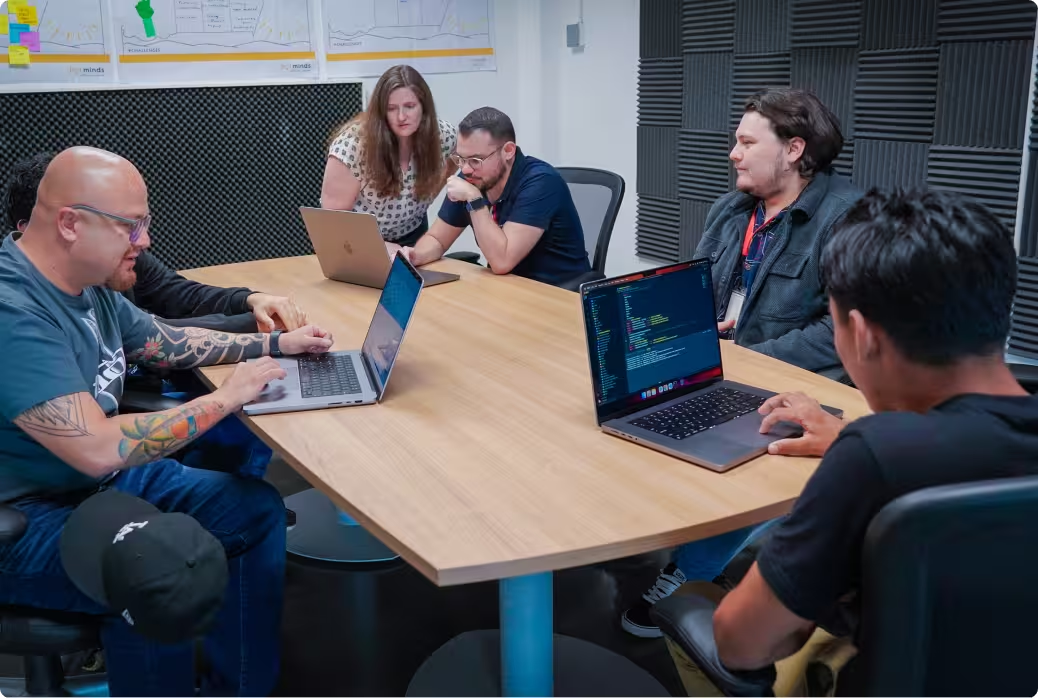
Most “agile nearshore” guides list the ceremonies without showing the cadence. Here is what a real two-week sprint with a Costa Rica-based team and a US Eastern client actually looks like. The sprint runs Monday-to-Friday across two calendar weeks, with at least four hours of daily overlap between 9am and 5pm Eastern.
Sprint planning Monday morning
Sprint planning is a 90-minute working session that runs no later than 10am Eastern on Monday of week one, with the entire team present synchronously. The product owner brings a prioritized backlog. The team commits to a sprint goal and the user stories that support it. Engineers size the stories together, and the scrum master calculates capacity against velocity from the last three sprints.
The session ends with three artifacts: a sprint backlog (locked), a capacity plan (with overflow tagged), and a definition-of-done for each story. Those artifacts live in one shared sprint document — Notion, Confluence, or a Google Doc — that becomes the canonical source of truth for the next 10 working days. McKinsey’s research on agile organizations notes a 60% improvement in project success rates over waterfall approaches (McKinsey on agility). The gain comes from a real sprint planning session, not from naming yourselves “agile.”
Mid-sprint check-ins and async work
Daily standups run 15 minutes inside the overlap window — typically 9:30am Eastern, which is 7:30am Costa Rica. Each engineer answers three questions: what I shipped yesterday, what I am shipping today, what is blocking me. The discipline is to keep the standup truly to 15 minutes and push detail to threads.
The rest of the day runs on Slack and Jira. Pull request review SLAs are 4 hours during overlap, next morning otherwise. Mid-sprint demo is on Wednesday of week two — a 30-minute working demo of what is built so far, with stakeholders invited. The mid-sprint demo is the early-warning system for missed sprint goals; if you cannot show working software by Wednesday of week two, the sprint is in trouble and the team can still adjust.
Async tools matter, but they support the sync work — they do not replace it. Loom is for handoffs between time zones. Slack is for unblocking and casual coordination. Email is for stakeholders outside the team. The rule is simple: anything that could become a 5-minute call gets one.
Sprint review, retro, and the handoff to next sprint
Friday of week two runs two ceremonies back to back. The sprint review is 60 minutes — a demo to stakeholders showing what was committed, what was shipped, and what was left behind. Stakeholders react in real time and the product owner captures their feedback for the next backlog grooming session.
The retro is 45 minutes, team-only. The format that works is “start / stop / continue” plus one process change the team commits to for the next sprint. Vent sessions are not retros. Durable improvements are.
Both ceremonies produce written artifacts. The review notes go to stakeholders by the end of day Friday. The retro action item lands in the next sprint backlog. Sprint zero — the onboarding ramp before sprint one — typically runs one to two calendar weeks, just enough to get developer access, codebase walkthrough, and the first round of pairing done.
The communication and tooling stack that actually works
The tools matter less than the operating agreements wrapped around them. The minimum viable stack is Jira or Linear for the backlog, Slack for async with channel-per-team conventions, Zoom for ceremonies, GitHub or GitLab for pull requests and CI/CD, and a shared documentation surface in Notion, Confluence, or Google Docs.
What separates winning teams is the operating rhythm: who responds to what within how many hours. Pull request reviews get a 4-hour SLA during overlap windows. Slack DMs get a same-day response, threaded follow-ups overnight. Blockers raised at standup get acknowledged with an owner and an ETA before noon. These response-time agreements are the actual product of a working agile nearshore engagement. The Jira board is the artifact.
One shared sprint document carries the load — definition of done, decisions log, and blockers list — and it lives in your tooling, not the partner’s. Async video tools like Loom handle cross-time-zone handoffs and demos so nothing depends on someone being online at midnight. Anti-patterns to watch for: tool sprawl, channel proliferation, and separate “vendor” Slack workspaces. If your nearshore engineers live in a side workspace and your in-house team has to remember to ping them, the operating model has already broken.
AI inside the 2026 agile nearshore workflow
AI tools are now baseline expectations, not differentiators. The differentiator is now governance. How a nearshore partner controls AI-generated code quality, IP exposure, and the gap between AI output and shippable code is what separates good shops from bad ones. AI executes. Engineers decide.
AI lands inside the sprint in five places: code generation for boilerplate, test generation for happy-path coverage, pull request review as a second pass, documentation drafting from the code itself, and retro insights pulled from sprint metrics. Each of those is a place where AI speeds the engineer up — and a place where bad AI output costs more than no AI output.
The engineers who get burned are the junior ones using AI to plug a skills gap. That maps to a partner-evaluation question: do their engineers have the seniority to use AI as a tool, or are they relying on it as a crutch?
IP and data exposure rules also matter. Ask any prospective partner what AI tools their engineers can use on your codebase, what data the tools can train on, and how the partner enforces those rules. If the answer is hand-waved, the AI governance is not real.
Agile nearshore for FinTech and healthcare — compliance done right
Regulated industries do not break agile. Bad partners do. The trick is mapping compliance evidence captured into your sprint. Every sprint review becomes an audit artifact. Every code review becomes evidence of segregation of duties. SOC 2 Type II, HIPAA, and PCI controls live inside the sprint, not in a binder somewhere.
SOC 2 Type II evidence works like this. Your sprint review minutes show that stakeholders reviewed and approved each deliverable — that is your change-management control. Your pull request approval log shows that no engineer merged their own code without a second reviewer — that is segregation of duties. Your Jira board shows that every production change traces back to a ticket — that is your audit trail. None of this requires breaking the sprint cadence. It requires using the artifacts the sprint already produces.
HIPAA-eligible work changes who can touch what. Developer access to PHI is scoped to the engineers who need it. Pull request reviews happen with PHI redaction in place. Logs and traces never include PHI in plain text. The agile cadence does not change; the data-handling controls do.
PCI scope reduction is its own discipline. The model that works is to keep PCI-scoped code in a small, well-isolated service that a tight subset of engineers maintains, while the rest of the team works on the broader product. That maps cleanly onto a staff augmentation model where named engineers stay on the PCI service for years.
For regulated work, staff augmentation often beats fixed-price for one practical reason: continuous evidence capture beats end-of-project audit. With staff augmentation, every sprint produces evidence. With fixed-price, you scramble to produce evidence in the last two weeks.
Costa Rica’s regulatory and labor infrastructure has been built up over 35+ years of multinational investment (CINDE). The country’s IT services market hit roughly $496 million in 2025 with a 5.41% CAGR, with the IT outsourcing sub-segment around $246 million (Statista Costa Rica IT Services 2026). That is not a coincidence — the data-protection alignment with US privacy frameworks is part of what built the market in the first place.
How to evaluate a nearshore partner (the seven questions to ask)
Every “how to choose a nearshore partner” guide on page one of Google lists the same generic criteria: check references, look at portfolio, evaluate communication. Those are table stakes. The questions that actually separate good nearshore partners from bad ones are sharper. These seven get to the real answers fast.
- Are your engineers full-time W-2-equivalent employees or contractors? This is the single most predictive question you can ask. Contractor-based models churn — engineers roll off in months, not years. Full-time models keep the same people on your account for the life of the engagement. Continuity is the asset; staffing model is the leading indicator.
- What is your engineer retention rate and your average client tenure? Two numbers, both should be readily available. Engineer retention tells you whether the team you sign with is the team you will have in year three. Client tenure tells you whether other clients found enough value to stay. At First Factory the average client tenure is more than three years; we have 25 years of operating history to back that up. If a partner cannot quote both numbers in the discovery call, they are likely hiding one or both.
- Show me a real two-week sprint from a current client engagement. Not slides. Artifacts. Sprint backlog, retro notes, pull request review history, demo recording. You are looking for evidence that the sprint cadence is real, not theater.
- What is your SOC 2 / HIPAA / PCI posture? Show me the report or the gap. For First Factory the answer is SOC 2 Type II in hand and an AWS Advanced Tier Partner audit trail. For a partner without SOC 2 Type II, the answer should at least be a credible plan with a target date.
- What does the team look like during your client’s peak hiring cycle for me? This tests bench depth. Every nearshore partner can staff one project; the better question is what happens when they are staffing five. If their answer involves contracting out the spillover, you are going to end up with the spillover engineers.
- How do you handle the AI governance question on my codebase? A credible partner has a written AI policy that covers which tools engineers can use, what data the tools can train on, and how the partner audits compliance. Hand-waving here is a red flag.
- What happens in the first 30 days if I want to end the engagement? This tests their confidence and their contract. At First Factory the answer is a 30-day risk-free guarantee for every resource, for the life of the engagement. If a partner cannot match that, you should know why before you sign.
When agile nearshore is the wrong choice
Agile nearshore is not universally the right answer. There are five scenarios where another model — onshore, fully in-house, or a different delivery framework — is the better choice. Naming them up front earns trust and screens out the wrong-fit prospects who would churn anyway.
Scope is genuinely fixed
Rare in software, but real for some regulated builds where every requirement is locked by contract or regulator before kickoff. Waterfall can be the right answer there. Latin American developer rates fell 7.1% year-on-year in 2025 (Accelerance 2026 Guide), but pricing alone does not make agile nearshore the right fit.
You need 24/7 follow-the-sun coverage
A pure nearshore team works your hours. If you need coverage during your overnight, you need an offshore + nearshore hybrid, not pure nearshore.
Your team is not ready for agile yet
No product owner, no backlog, no definition of done. Bringing on a nearshore agile partner before your in-house process is in place will not fix the process — it will expose how raw it is. Get your house in order first.
Highly sensitive on-premise hardware work
Some embedded systems, manufacturing automation, and lab-bound projects require physical presence. Nearshore engineers cannot help.
Engagements that need deeply embedded US-only political relationships
Government contracts and some defense-adjacent work fall here. If the work depends on US citizenship or US-only clearances, nearshore is not the model.
The honest test is whether your project actually benefits from sprint-based iteration with senior engineers in your time zone. If yes, agile nearshore is one of the highest-leverage decisions you can make. If no, find the model that fits.
.avif)